

Best overall: a rounded, closed-wall vase. Best for sculptural display: a pierced vase. Best for a shallow shelf: a squat vase. This Folk Heart Cafe guide compares Oaxaca black pottery vases by form and placement for modern interiors in 2026; the recommendations are shape categories, not individual products.
- For Oaxaca black pottery vases, choose a rounded, closed-wall form as the default decorative centerpiece.
- Choose pierced barro negro for sculpture, not for holding water or concealing stems.
- Use tall, narrow-neck vases for restrained dried arrangements; choose squat forms for shallow shelves.
- Confirm origin, dimensions, and water suitability before choosing any individual vase.
Why this matters
A black vase does not automatically work in a modern room. Its outline, opening, surface, and relationship to nearby objects determine whether it looks deliberate or crowded.
Barro negro is a pottery tradition associated with Oaxaca, particularly San Bartolo Coyotepec. Its characteristic dark appearance comes from its production and firing process; polished examples also use burnishing to develop their surface sheen. Black color alone does not establish an object's origin.
For a modern interior in 2026, start with the job: empty sculpture, dried arrangement, or fresh flowers. Those uses demand different things. A pierced vessel has visible openings, while a closed-wall vessel still needs explicit confirmation before you treat it as watertight.
Folk Heart Cafe recommends rounded Oaxaca black pottery vases for readers who want an uncomplicated decorative focal point. Choose another shape when your placement or arrangement calls for it.
What makes the best Oaxaca black pottery vases?
Judge the vessel against these criteria before choosing a silhouette:
- Documented origin: Look for a named maker, workshop, or production location. A dark finish is not proof of Oaxacan craftsmanship.
- Useful proportions: Compare the widest point, overall height, and base with the actual surface where the vase will sit.
- Suitable opening: A narrow neck helps gather stems; a broad mouth leaves more room for arranging them.
- Appropriate walls: Closed walls conceal the interior. Pierced walls make openings and shadows part of the display.
- Readable finish: Examine the surface under ordinary room lighting, not only directional photography. Look closely at marks, sheen, and decoration.
- Confirmed function: Treat decorative use and water-holding use as separate requirements. Get explicit care instructions for the individual piece.
There is no budget winner in this 2026 guide. Shape alone cannot establish value, and an inexpensive-looking silhouette says nothing reliable about workmanship or origin.
Oaxaca black pottery vases at a glance
The order below reflects distinct decorating needs, not a claim that one maker outperforms another.
| Rank and vase form | Best for | Standout feature | Key limitation |
|---|---|---|---|
| 1. Rounded, closed-wall vase | A default tabletop focal point | A complete silhouette without stems | A broad body takes up surface space |
| 2. Tall, narrow-neck vase | Sparse dried branches | A concentrated opening for a vertical arrangement | Less flexible for broad bouquets |
| 3. Pierced vase | Sculpture displayed empty | Openwork that changes with the background | Openings prevent direct water use |
| 4. Squat vase | Shallow shelves and low displays | A low profile beneath artwork or shelving | Short height limits long-stem arrangements |
| 5. Wide-mouth vase | Fuller dried arrangements | An accessible opening for stem placement | Sparse stems need additional support |
1. Rounded, closed-wall vase: best for a tabletop focal point
A rounded vase puts the body of the pottery first. Its outline remains legible without flowers, making it the strongest default when you want one object to anchor a console, sideboard, or table.
Choose a version whose curves remain clear against the background. A dark vessel against a dark wall needs enough separation or light for its outline to read; otherwise, the form disappears into the setting.
Best for: A decorative centerpiece that looks finished when empty.
Rounded vase pros:
- The complete body gives you a clear silhouette without an arrangement.
- Closed walls keep loose stems and interior supports out of sight.
- A simple outline leaves room for nearby textiles or artwork to carry detail.
Rounded vase cons:
- A broad body occupies more usable surface than its neck suggests.
- Closed walls do not prove that the vessel holds water safely.
Place the vase off-center if it shares a console with a lamp. Leave enough separation for both outlines to remain distinct rather than stacking their profiles visually.
For your 2026 shortlist, this is the default unless you already have a specific arrangement or restrictive shelf location in mind.
Verdict: Buy a rounded, closed-wall form for a standalone decorative focal point.
2. Tall, narrow-neck vase: best for sparse dried branches
A tall vase draws attention upward, while a narrow neck brings stems together at the opening. This combination suits a restrained arrangement rather than a dense bouquet.
Check the relationship between the base and the intended branches. A slender appearance is not evidence of stability, and an arrangement should not pull the vessel noticeably to one side.
Best for: A small grouping of dried stems beside low furniture or artwork.
Tall vase pros:
- The neck gathers stems without a broad opening around them.
- The vertical outline contrasts with a horizontal console or sideboard.
- A restrained arrangement leaves much of the pottery visible.
Tall vase cons:
- A narrow opening restricts thicker stems and dense arrangements.
- Tall branches demand attention to balance and overhead clearance.
Use the vase where branches will not brush a walkway, curtain, or cabinet door. Look at the entire arrangement from the room entrance, not just from directly in front of the table.
Choose branches that complement the vessel's scale. Forcing an oversized stem into a small opening risks damaging both the arrangement and the pottery.
Verdict: Buy a tall, narrow-neck form for sparse dried branches; skip it for broad bouquets.
3. Pierced vase: best for sculptural display
A pierced vase uses cut openings as part of its design. The background becomes visible through the body, so the wall, shelf, and neighboring objects all affect how the pattern reads.
Display it empty when the openwork is the main attraction. Stems and supports inside the vessel become additional visible elements rather than disappearing behind a solid surface.
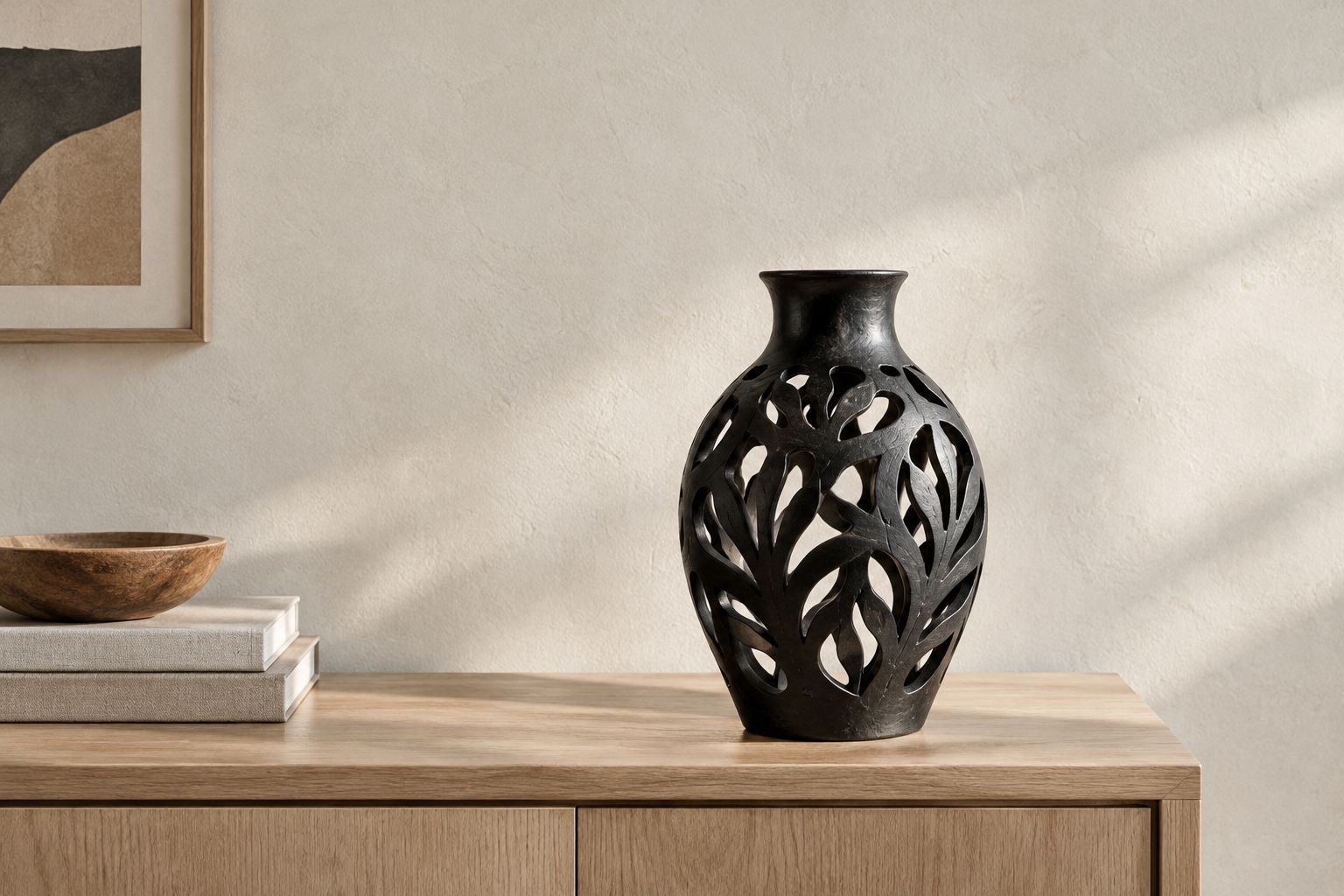
Best for: An empty vessel treated as sculpture.
Pierced vase pros:
- Openings give the object detail without requiring flowers.
- A contrasting background makes the cut pattern easier to see.
- The relationship between solid clay and empty space adds visual interest.
Pierced vase cons:
- Openings prevent the vessel from holding water directly.
- Intricate sections require careful handling and gentle dusting.
Avoid treating pierced pottery as a candle holder unless the maker explicitly identifies that use as safe. Openwork alone says nothing about suitability for heat or flame.
Verdict: Buy pierced pottery for sculpture; skip it when you need a direct-use flower vessel.
4. Squat vase: best for shallow shelves
A squat vase keeps the display low. Its shape suits a shelf beneath artwork, a compact side table, or a bookcase compartment where a tall arrangement would crowd the space above.
Measure the widest part of the body rather than relying on height alone. A low vase can still be too deep for a narrow ledge.
Best for: Low displays with limited overhead clearance.
Squat vase pros:
- The low outline leaves more of the wall or artwork visible.
- A compact arrangement keeps the display close to the shelf.
- The rounded mass provides contrast beside upright books.
Squat vase cons:
- Long stems need shortening or a different vessel.
- A broad body can project beyond a shallow shelf.
Place the entire base on a stable surface, with no overhang. Keep the vase clear of books that you pull out frequently; a display should not turn routine use into a handling problem.
Choose an empty display or a short dried arrangement when you want the pottery itself to remain the focus.
Verdict: Buy a squat form for low shelves after checking its full depth.
5. Wide-mouth vase: best for fuller dried arrangements
A wide-mouth vase gives you room to spread stems across the opening. It suits arrangements where the flowers or foliage matter as much as the ceramic body.
That flexibility brings a trade-off: a broad opening does less to hold a sparse arrangement together. Plan the stem structure rather than expecting the neck to gather everything for you.
Best for: Fuller dried arrangements with visible spread.
Wide-mouth vase pros:
- The opening allows more freedom when positioning stems.
- Fuller arrangements do not need to squeeze through a narrow neck.
- You can see and adjust the interior arrangement more easily.
Wide-mouth vase cons:
- Sparse stems need additional support to stay in position.
- A full arrangement can obscure the pottery's outline.
Do not wedge hard supports against delicate edges. If you want to use fresh flowers, confirm water suitability and care requirements for the exact vessel before adding water.
Verdict: Buy a wide-mouth form for fuller dried arrangements; skip it for an unsupported single stem.
Check the fit before choosing a vase
A product photograph cannot tell you whether a vessel fits your room. Use dimensions to make a simple physical mock-up before committing to a shape.
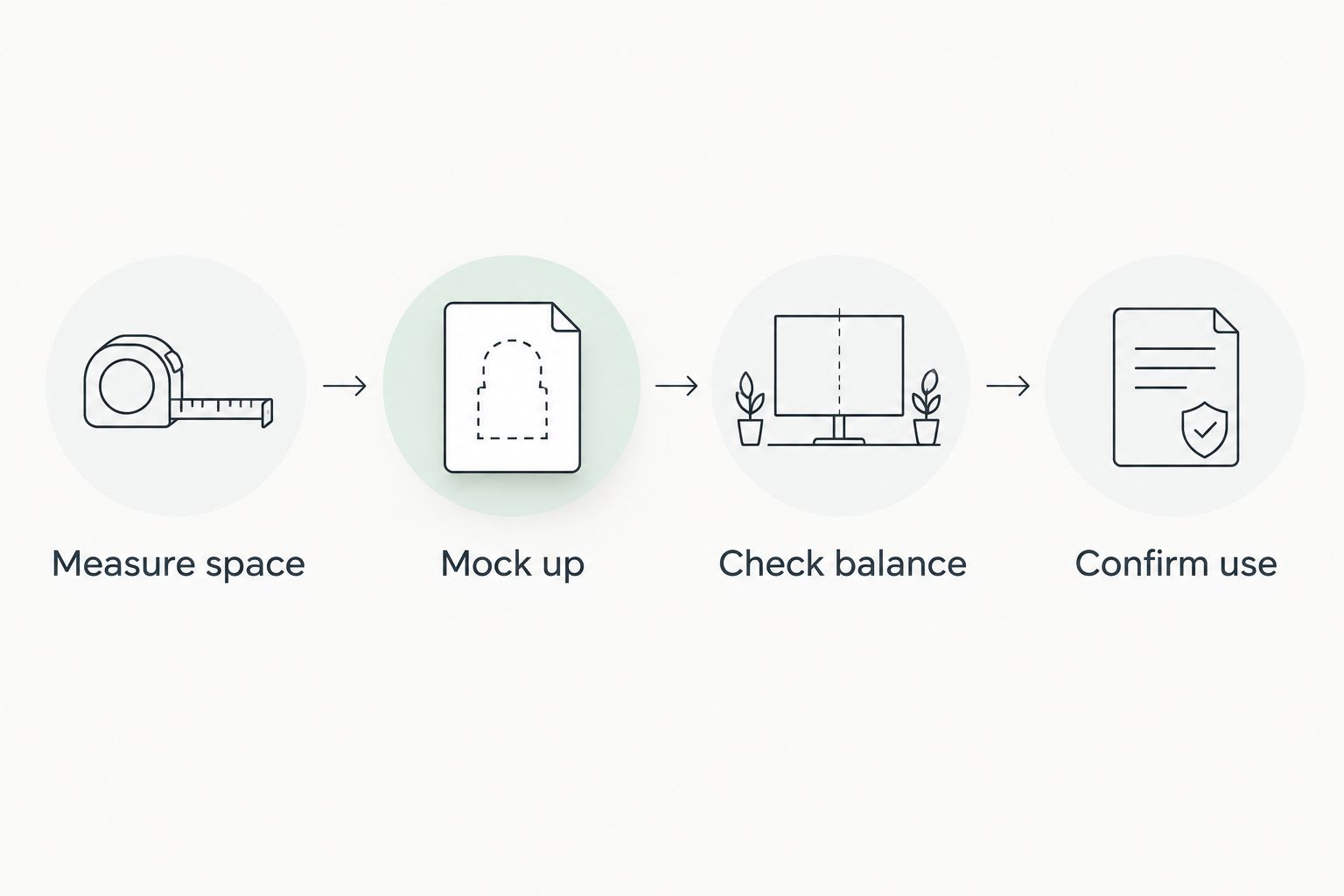
Follow this sequence:
- Measure space: Record the usable surface, overhead clearance, and distance from doors or curtains.
- Mock up: Cut a paper silhouette using the candidate vase's stated height and width. Add a separate outline for the intended arrangement.
- Check balance: Stand back and assess the vase beside the objects that will remain in place.
- Confirm use: Check the individual vessel's origin, opening, base, and care instructions.
For example, compare paper silhouettes measuring 8 inches, 12 inches, and 16 inches tall. These are suggested planning examples, not dimensions of any recommended product. Give each mock-up the candidate vessel's actual width; height alone is not enough.
For a 2026 room refresh, test the vase with your existing furnishings first. Replacing surrounding objects should not be necessary just to make the new vessel fit.
How the forms are ranked
Folk Heart Cafe ranks these forms by how directly they solve a decorating need: standalone presence, vertical arrangement, sculptural detail, low clearance, or bouquet spread. The criteria are origin, proportions, opening, wall structure, finish, and intended function.
This is not a hands-on product test or a maker ranking. Individual workmanship, condition, and care requirements still need checking on the specific piece you choose.
Which Oaxaca black pottery vase should you choose?
Choose a rounded, closed-wall vase if you are undecided. It gives you a complete decorative object without requiring stems, openwork, or a particular shelf height.
Choose a tall neck for sparse branches, pierced walls for empty sculpture, a squat body for low clearance, and a wide opening for fuller dried arrangements. Buy for the display you actually want, not for every possible use.
The strongest 2026 choice is the form that fits your surface and remains visually clear from across the room.
FAQ
What's the best shape for Oaxaca black pottery vases in a modern room?
A rounded, closed-wall vase is the best default for a standalone decorative focal point. Choose another form when a particular arrangement or shelf location requires it.
Can I put water in an Oaxaca black pottery vase?
Use water only when the maker confirms that the individual vase is suitable for it. Closed walls and a polished surface do not establish watertightness, and pierced vessels cannot hold water directly.
Is barro negro the same as any black ceramic vase?
No. Barro negro refers to a pottery tradition associated with Oaxaca, particularly San Bartolo Coyotepec; black color alone does not establish that origin. Look for maker or workshop information.
Are pierced black pottery vases better displayed empty?
An empty display keeps pierced pottery's openwork as the main attraction. Stems and supports remain visible through the openings and change how the pattern reads.
Which vase shape works best on a shallow bookshelf?
A squat vase suits a low bookshelf display, provided its full body and base fit the shelf depth. Measure the widest point rather than choosing by height alone.
How do I choose between a narrow neck and a wide opening?
Choose a narrow neck for sparse dried stems and a wide opening for fuller dried arrangements. A wide mouth gives you more positioning room but provides less support for isolated stems.
How should I clean a black pottery vase?
Follow the maker's care instructions for the individual vessel. Avoid assuming that soaking, abrasive cleaning, or dishwasher use is suitable, especially for decorative finishes and pierced sections.
One last thing
Judge the empty vase before adding anything to it. An arrangement can hide the very curve, opening, or surface that made you choose the pottery.
Folk Heart Cafe's final recommendation is to photograph your paper mock-up from the doorway. If the outline already feels crowded, change the shape before trying to solve the problem with flowers.

