

Best overall: a framed Oaxacan textile. Best for a flat gallery wall: a print by an identified Oaxacan artist. Best for sculptural storytelling: Oaxacan Woman Selling Pots on a secured wall shelf. The right Oaxacan folk art for wall decor depends on whether you want something that hangs directly or an object displayed against the wall.
- For Oaxacan folk art for wall decor, choose a framed textile as the main focal piece.
- Choose a print by an identified Oaxacan artist for a flat gallery-wall arrangement.
- Folk Heart Cafe's Oaxacan Woman Selling Pots suits a ceramic shelf display, not improvised hanging.
- Treat ceramic figures and pitchers as freestanding objects unless their maker specifies a hanging method.
Why this matters
A ceramic figure and a woven textile ask different things of your wall. One needs a stable supporting surface; the other needs a framing or hanging system suited to its material. Choosing the display method first prevents you from buying an object that cannot safely occupy the space you have.
Folk Heart Cafe includes Oaxacan ceramic figures and pitchers among its products. Those pieces belong in this guide as wall-shelf options, not as substitutes for purpose-made hanging art. For your 2026 room refresh, separate those two categories before choosing a favorite.
What makes the best Oaxacan folk art for wall decor
Use these criteria to assess both the artwork and the way you intend to display it:
- Maker and origin: Look for an identified artist, workshop, or community. A decorative motif alone does not establish Oaxacan origin.
- Display compatibility: Distinguish a hanging work from a freestanding object. Do not assume pottery handles, necks, or decorative openings are attachment points.
- Visual hierarchy: Plan 1 focal piece per grouping. Supporting pieces should complement it rather than compete for attention.
- Material care: Consider light exposure, dust, humidity, and whether the work needs glazing or an enclosed display.
- Room fit: Match the artwork's shape and visual detail to the wall and viewing distance, not just the room's colors.
- Installation requirements: Confirm the complete framed weight or shelf load, then select hardware appropriate to the wall construction.
Choose the display format before choosing the object. A beautiful ceramic figure is the wrong purchase for a wall where you cannot install a suitable shelf.
Best options at a glance
This 2026 shortlist ranks display approaches, with named ceramic examples where the product details establish a clear fit. The order reflects usefulness for wall decorating, not a judgment about the artistic value of one tradition over another.
| Rank and option | Best for | Standout feature | Key limitation |
|---|---|---|---|
| 1. Framed Oaxacan textile | A single focal wall | Woven texture and a broad visual field | Needs material-appropriate support and framing |
| 2. Print by an identified Oaxacan artist | A flat gallery wall | A two-dimensional work that fits a framed arrangement | Paper and inks need protection from damaging exposure |
| 3. Oaxacan Woman Selling Pots | Narrative ceramic shelf display | Leticia Aguilar's depiction of a market woman balancing pottery | Requires a stable shelf; not presented as a hanging object |
| 4. Oaxacan Necklace Hen Pitcher (Jarrito) | A sculptural shelf accent | Guillermina Aguilar's hen-pitcher form | Projects into the room and needs supporting depth |
The first two options occupy the wall plane. The ceramic options bring depth but also introduce a shelf, brackets, and a projecting object into your layout.
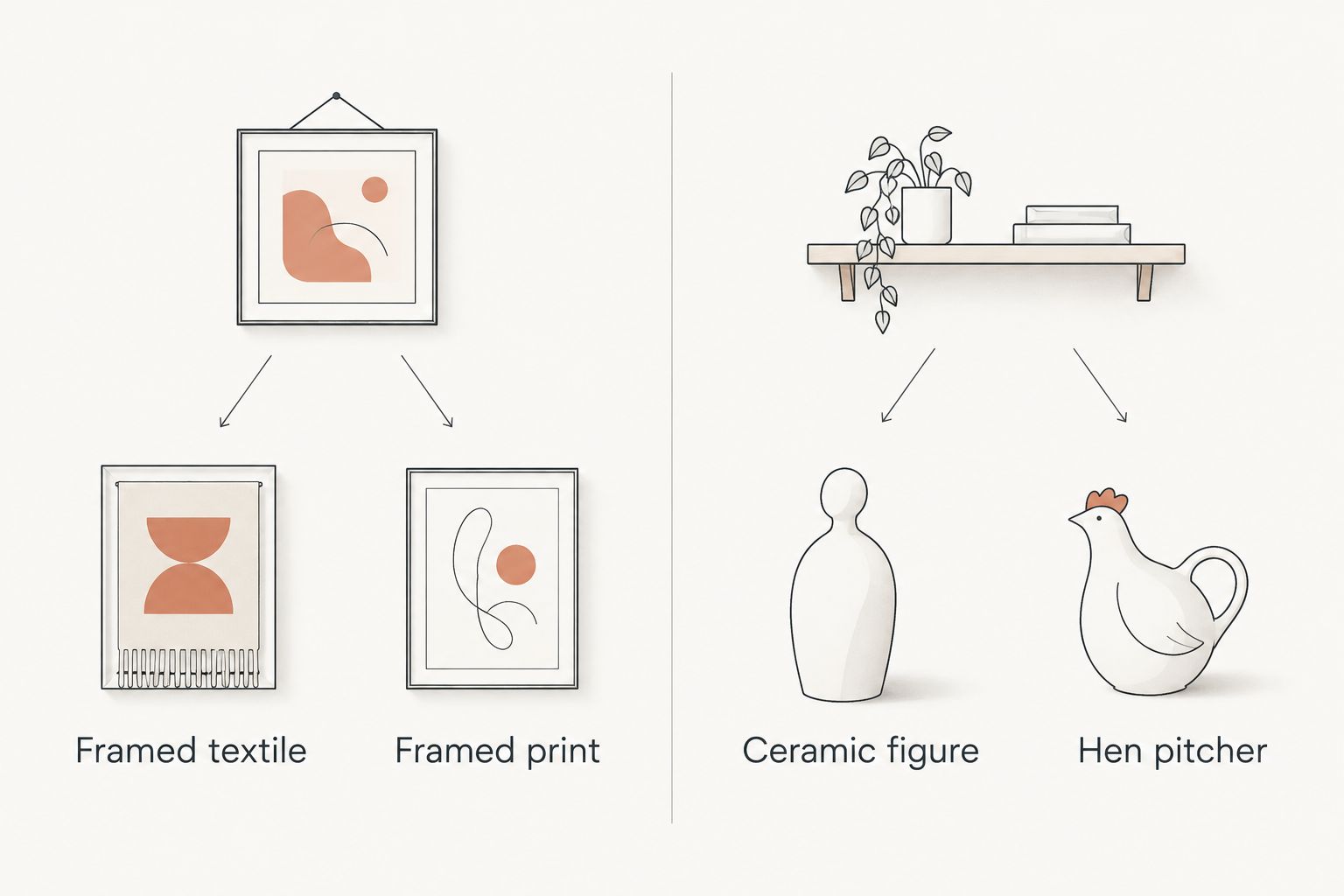
1. Framed Oaxacan textile: best for a single focal wall
A framed Oaxacan textile is the strongest default when you want the artwork itself to define a wall. Weaving contributes surface texture as well as pattern, so the piece remains visually distinct from a printed reproduction.
Choose a work with documented origin and a support method appropriate to its construction. Do not assume every textile can hang from clips or tolerate adhesive attachment; ask a framer experienced with textiles how the particular piece should be supported.
Framed Oaxacan textile pros:
- Combines pattern and physical texture in one focal piece.
- Works as a standalone composition without a surrounding collection.
- Keeps the display relatively close to the wall compared with shelf-mounted objects.
Framed Oaxacan textile cons:
- Framing and support require attention to the textile's condition and construction.
- A large, visually busy piece can dominate nearby art and furnishings.
Best for: You want one central artwork rather than a collection of smaller objects.
Start with the textile's pattern scale, not a matching cushion or paint swatch. View the work from across the room and nearby: a composition that reads clearly at a distance can reveal its woven detail as you approach.
Verdict: Buy a documented textile when you want a wall-hung focal piece and can provide suitable support.
2. Oaxacan artist print: best for a flat gallery wall
A print by an identified Oaxacan artist is the clearest choice when you need framed art rather than projecting objects. It belongs in a gallery-wall arrangement without requiring a shelf underneath it.
Check whether the work is an original print, a reproduction, or another printed format. Those descriptions are not interchangeable, and the listing should identify what you are buying rather than relying on a regional style label.
Oaxacan artist print pros:
- Fits alongside other framed works in a flat arrangement.
- Lets you select imagery with a clear narrative or graphic focus.
- Avoids the shelf-depth requirements of pottery.
Oaxacan artist print cons:
- Paper and colorants require appropriate framing and light management.
- A reproduction and an original print offer different collecting propositions.
Best for: You are extending an existing gallery wall or decorating beside a circulation route where projecting objects would interfere.
For a 2026 gallery-wall update, use consistent spacing or a shared frame finish to connect different works. You do not need every image to share the same subject; the arrangement needs a readable structure.
Verdict: Buy a clearly described print when a flat, framed arrangement matters more than sculptural depth.
3. Oaxacan Woman Selling Pots: best for narrative shelf decor
Oaxacan Woman Selling Pots is a barro policromado figure by Leticia Aguilar, handmade in Ocotlán de Morelos. The figure depicts a traditional Oaxacan market woman balancing pottery, giving the display an identifiable subject rather than an abstract accent.
Folk Heart Cafe's Oaxacan Woman Selling Pots is the pick for wall-shelf decor centered on a market scene. Treat the figure as freestanding pottery: the display recommendation is a secured shelf, not a hook or wire attached to the figure.
Oaxacan Woman Selling Pots pros:
- Has an identified maker and place of production.
- Presents a specific market subject through a ceramic figure.
- Adds a three-dimensional focal point against a plain wall.
Oaxacan Woman Selling Pots cons:
- Requires a supporting surface rather than direct hanging.
- Needs protection from knocks and from objects crowded around it.
Best for: You want a small narrative display whose subject rewards a closer look.
Leave the area around the balanced pottery visually clear. A busy frame arrangement directly behind the figure competes with the details that make the subject legible.
Verdict: Buy for a properly supported shelf display; skip for a wall that only accommodates hanging frames.
4. Oaxacan Necklace Hen Pitcher: best for a sculptural accent
Oaxacan Necklace Hen Pitcher (Jarrito) uses the hen-pitcher form described as a classic signature of Guillermina Aguilar. The product description connects the form with Oaxacan tradition and household utility, making it a distinct alternative to a human figure.
For wall decor, approach the pitcher as a sculptural object on a shelf. Its vessel form does not establish a wall-mounting method, and its decorative appeal does not establish suitability for food or drink use.
Oaxacan Necklace Hen Pitcher pros:
- Offers an animal subject rather than another framed image.
- Adds a vessel silhouette to a shelf composition.
- Connects the display to an identified artist's hen-pitcher form.
Oaxacan Necklace Hen Pitcher cons:
- Needs enough shelf depth for its complete footprint.
- Is a poor fit where people or moving furniture could strike it.
Best for: You want a sculptural accent on a wall shelf without building the display around a human figure.
Choose the pitcher or the market figure as the main shelf object rather than automatically pairing them. A single clear silhouette often makes a more readable arrangement than several equally prominent objects.
Verdict: Buy for a suitable shelf where the hen form can stand apart; skip improvised hanging.
Plan the display before choosing the ceramics
For either ceramic option, the shelf is part of the purchase decision. Confirm the object's dimensions and weight, the shelf manufacturer's load guidance, and the fixings required for your wall before installation.
Make 1 paper template for each frame and mark a proposed shelf footprint with removable tape suited to your wall finish. This lets you assess the arrangement before drilling; it does not replace checking the structure or hardware.
Check the layout from 3 viewing positions: the doorway, your main seated position, and directly in front of the display. Look for blocked details, glare on framed work, and shelf corners that intrude into a walking route.
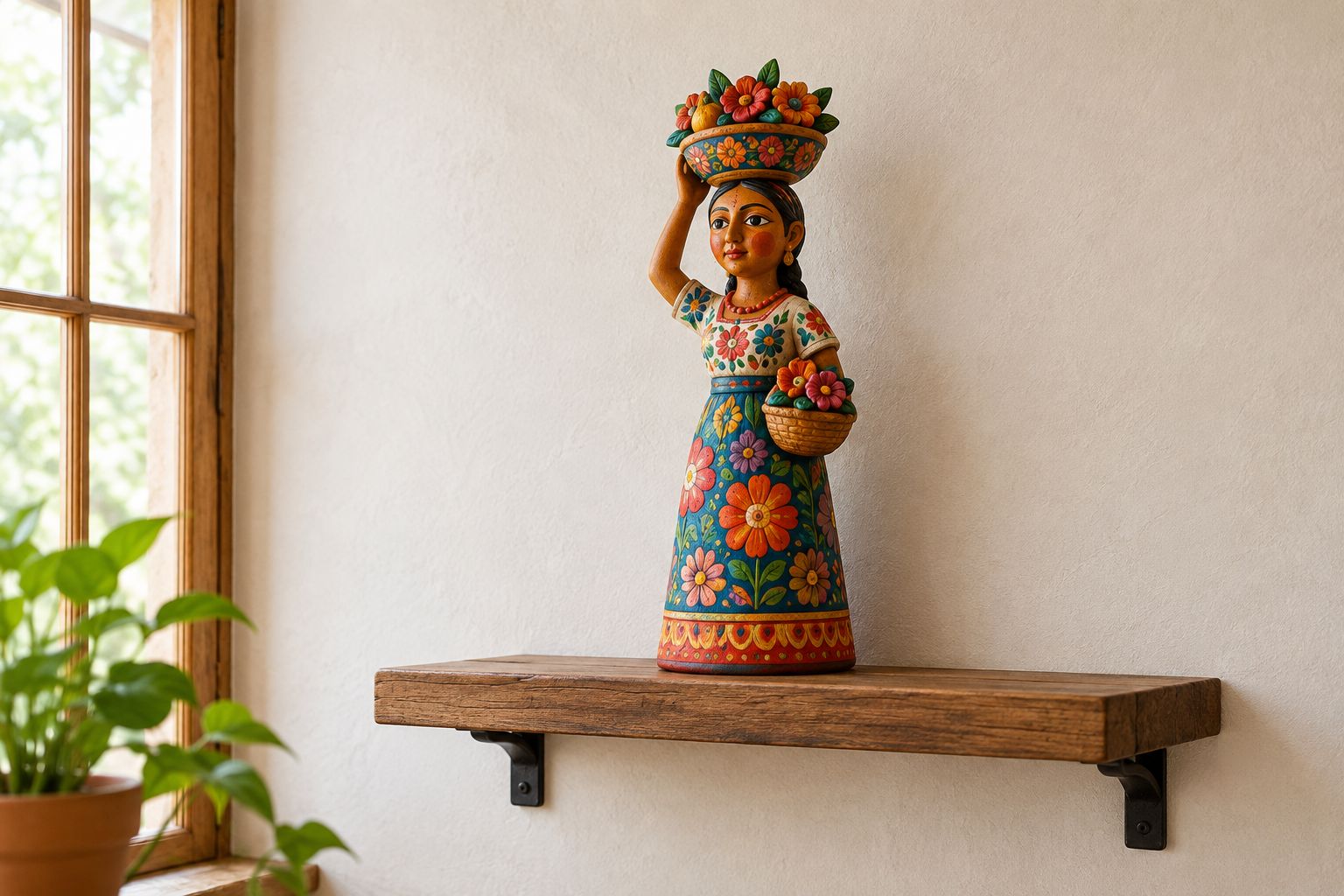
Once you have established that a shelf display suits your room, compare the ceramic subjects below. Choose for the story or shape you want to see every day, not simply to fill an empty stretch of wall.


How the options were ranked
This 2026 ranking prioritizes compatibility with wall display, followed by visual role, maker identification, material care, and installation requirements. Framed formats lead because they directly answer a wall-hanging need; freestanding ceramics follow because they require additional support.
The ceramic recommendations use their stated artist, origin, and subject details. The ranking does not treat a product photograph as evidence of hanging hardware, dimensions, or a safe installation method.
Which Oaxacan wall decor should you choose?
Choose a framed textile if you are undecided. It provides a clear focal format without requiring you to assemble a collection.
Choose an artist print for a gallery wall. Choose Folk Heart Cafe's ceramic options for Oaxacan wall-shelf decor only when the room and installation support a projecting display. The distinction is practical: decide whether you need something that hangs or something that stands.
FAQ
What's the best Oaxacan folk art for wall decor in 2026?
A framed Oaxacan textile is the best default for a single focal wall. Choose a print for a flat gallery arrangement, or a ceramic figure on a secured shelf for sculptural depth.
Can I hang an Oaxacan ceramic figure directly on the wall?
Use a shelf unless the maker explicitly provides a wall-hanging method. Do not treat a figure's decorative openings or projecting details as attachment points.
Is a textile better than a print for an Oaxacan gallery wall?
A print is the more direct fit for a gallery wall made of framed images. Choose a textile when woven texture and a standalone focal piece are your priorities.
Which Folk Heart Cafe piece suits a market-themed display?
Oaxacan Woman Selling Pots suits a market-themed shelf display. The barro policromado figure by Leticia Aguilar depicts a traditional Oaxacan market woman balancing pottery.
How do I check whether a piece is actually from Oaxaca?
Look for specific maker and origin information rather than relying on motifs or the word Oaxacan alone. Ask the seller to clarify attribution and production location when the description is unclear.
What should I measure before installing a ceramic wall shelf?
Check the object's full footprint, height, and weight alongside the shelf's dimensions and load guidance. The shelf and fixings must also suit the wall construction.
Should Oaxacan folk art go in direct sunlight?
Keep light-sensitive textiles, paper works, and painted surfaces out of direct sunlight. Choose placement and protective framing according to the particular materials rather than assuming all folk art tolerates the same conditions.
One last thing
For your 2026 display, test the background before adding more objects. Place a plain sheet behind a shelf figure temporarily: if the subject becomes easier to read, simplify the surrounding wall rather than expanding the collection.

