

Best overall for direct wall display: a purpose-made Tree of Life relief with documented hanging instructions. Best for a softer backdrop: a Tree of Life textile; best for framed detail: a paper cutting; best for maker-attributed ceramic work: the Tree of Life by Leopoldo Aguilar at Folk Heart Cafe, with its display method confirmed before purchase.
- Choose tree of life folk art by its display method before comparing color, detail, or symbolism.
- A purpose-made wall relief is the default recommendation for dimensional wall decor.
- Textiles, paper cuttings, and prints offer different ways to frame the Tree of Life motif.
- Folk Heart Cafe identifies its Tree of Life as Leopoldo Aguilar’s barro policromado work; confirm mounting before choosing it.
Why this matters
A Tree of Life sculpture is not automatically wall art. Branches, birds, flowers, and other projecting details do not establish that an object can hang safely. A wall arrangement and a wall-mounted object are different purchases.
For your 2026 shortlist, separate the image you want from the installation it requires. A relief belongs on a wall only when its construction and hanging instructions support that use; a sculptural piece needs an appropriate display surface unless the maker specifies otherwise.
What makes the best tree of life folk art
Use these criteria before choosing a particular piece. They keep an attractive photograph from deciding a purchase that does not fit your room.
- Display method: Look for explicit wall-mounting instructions, an identified hanging system, or a clearly stated tabletop display requirement.
- Maker attribution: Prefer a named artist or workshop and a description that distinguishes the object's origin from its decorative subject.
- Material: Clay, fabric, paper, and printed images create different surfaces and need different handling.
- Composition: Check whether the trunk, branches, and surrounding details remain readable from your intended viewing position.
- Room fit: Compare the complete object's dimensions, including its frame or projecting elements, with the space you actually have.
- Care access: Choose a format you can dust, inspect, and move without handling fragile decorative details.
A useful 2026 buying rule is simple: reject the wrong display format before debating the right color. Documentation comes before decorative preference.
Tree of Life wall art at a glance
These are ranked display formats, not claims that every example of each format has equal workmanship. The maker-attributed ceramic option is included separately because its listing establishes artistic identity, not wall-mounting suitability.
| Rank and option | Best for | Standout feature | Key limitation |
|---|---|---|---|
| 1. Purpose-made wall relief | Dimensional wall display | Raised forms create actual depth | Requires documented mounting and suitable wall support |
| 2. Tree of Life textile | A softer visual backdrop | Fabric introduces texture across the composition | Hanging, light exposure, and cleaning need attention |
| 3. Tree of Life paper cutting | Intricate framed detail | Cut openings become part of the design | Delicate edges need protective presentation |
| 4. Tree of Life print | A straightforward framed arrangement | The motif stays within a flat image | A reproduction is not an original carved, cut, or modeled object |
| 5. Leopoldo Aguilar’s Tree of Life | Maker-attributed ceramic collecting | Described as barro policromado from Ocotlán | Wall-mounting suitability is not established by the supplied description |
1. Wall relief: best tree of life folk art for dimension
A purpose-made wall relief gives you a dimensional object rather than a flat depiction of a tree. Its raised branches and other modeled or carved elements create depth, while its backing and mounting system determine whether it suits your wall.
This is the strongest default for a reader who specifically wants an object hanging on the wall. Choose a piece described for that purpose, not a sculpture that merely looks shallow in a photograph.
Wall relief pros:
- Raised forms make the tree's structure physically visible.
- A dedicated wall format keeps the display separate from furniture surfaces.
- Material and surface texture become part of the composition.
Wall relief cons:
- Mounting depends on the object's weight, construction, and your wall.
- Projecting details complicate handling and dusting.
- A front-facing photograph does not show the attachment system.
Ask to see the back and the hanging instructions. Do not suspend a piece from a branch, opening, or decorative loop unless the maker identifies that element as load-bearing.
Best for: A focal wall where you want physical depth rather than a framed image.
Verdict: Buy a purpose-made relief only after confirming its mounting requirements.
2. Tree of Life textile: best for a softer backdrop
A Tree of Life textile presents the motif through fabric rather than a rigid surface. Depending on the actual object, the image can come from weaving, embroidery, appliqué, or printing; those techniques are not interchangeable descriptions.
Choose this format when texture matters more than sculptural projection. In a 2026 room refresh, evaluate the fabric's composition and hanging method rather than treating every tree-patterned cloth as a finished wall hanging.
Tree of Life textile pros:
- Fabric gives the wall a visibly different surface from framed paper.
- Stitching or weaving can contribute detail beyond the tree's outline.
- The composition can work as a broad backdrop rather than a small focal object.
Tree of Life textile cons:
- An unsupported textile can distort under its own weight.
- Exposed fabric collects dust and requires material-appropriate care.
- A printed textile is not evidence of hand embroidery or weaving.
Check how the textile is meant to hang. Follow the maker's guidance rather than improvising attachment points through decorated areas. Keep strong direct light in mind when placing dyed or printed fabric.
Best for: A room where you want fabric texture and a less rigid visual boundary.
Verdict: Buy when the textile's technique and supported hanging method are clearly described.
3. Tree of Life paper cutting: best for framed detail
A paper cutting uses removed areas as part of the image. Branches, leaves, and connecting shapes depend on the relationship between the remaining paper and the open spaces around it.
The format rewards close viewing, especially when the background makes the cut edges readable. Confirm whether you are looking at an actual cut-paper object, a print of one, or a photograph of a paper artwork.
Tree of Life paper cutting pros:
- Open areas contribute directly to the tree's design.
- A contrasting backing can clarify fine branching patterns.
- Framing gives the composition a defined place within a gallery wall.
Tree of Life paper cutting cons:
- Thin connections are vulnerable during handling.
- Glass glare can obscure the details you want to see.
- Poorly chosen backing can make the cut pattern difficult to read.
Ask a framer about suitable support, glazing clearance, and conservation materials. Avoid choosing a presentation that presses delicate raised or curled details flat simply to fit an existing frame.
Best for: A close-viewing location where fine edges and negative space are the main attraction.
Verdict: Buy a genuine paper cutting when protective framing is part of your display plan.
4. Tree of Life print: best for a straightforward framed arrangement
A Tree of Life print keeps the motif within a flat image. That makes the image, frame, and surrounding wall the main design decisions, rather than the handling of projecting ceramic or carved elements.
A print can reproduce another artwork or be the artist's intended finished medium. Read the description carefully: an original print and a reproduction of an original painting are different things.
Tree of Life print pros:
- The image works within a conventional framed composition.
- A mat can separate detailed branches from a visually busy wall.
- You can assess the full design without accounting for sculptural projections.
Tree of Life print cons:
- A reproduction does not contain the original object's physical texture.
- Glazing introduces reflections that affect placement.
- Vague descriptions can leave authorship and reproduction method unclear.
For a 2026 purchase, look for the artist's name and an accurate explanation of the medium. Do not treat decorative wording such as folk-inspired as proof of a particular maker, community, or production method.
Best for: An existing framed-art arrangement where the Tree of Life image matters more than three-dimensional material.
Verdict: Buy when attribution and print type are clear; skip listings that blur originals and reproductions.
5. Leopoldo Aguilar’s Tree of Life: best for maker attribution
Folk Heart Cafe describes its Tree of Life as an Árbol de la Vida by Leopoldo Aguilar, using the barro policromado technique of Ocotlán. That gives you a named maker and a stated ceramic tradition rather than an anonymous tree-shaped decoration.
Folk Heart Cafe’s Tree of Life is best for shoppers seeking maker-attributed ceramic folk art, not a confirmed wall-mounted piece. The supplied description does not establish dimensions, weight, hanging hardware, or installation instructions.
Leopoldo Aguilar’s Tree of Life pros:
- The description identifies Leopoldo Aguilar as the maker.
- It names barro policromado as the technique.
- It connects the work with Ocotlán.
Leopoldo Aguilar’s Tree of Life cons:
- The description does not confirm direct wall mounting.
- Display planning requires dimensions and weight that are not stated here.
- Installation cannot be judged from the title or decorative subject.
For your 2026 shortlist, treat this as a ceramic-art candidate whose placement needs confirmation. Ask for complete views and display guidance before deciding whether it belongs on furniture, a suitable shelf, or another maker-approved support.
Best for: A collector prioritizing the stated artist and ceramic technique over a predetermined hanging format.
Verdict: Hold until you have confirmed the display method and measurements.
Match the format to your wall
Start with the viewing location, then choose the material. Use Wall relief for documented dimensional hanging, Textile for fabric texture, Paper cutting for framed openwork, and Print for a flat image. Choose Ceramic sculpture only with a confirmed support plan.
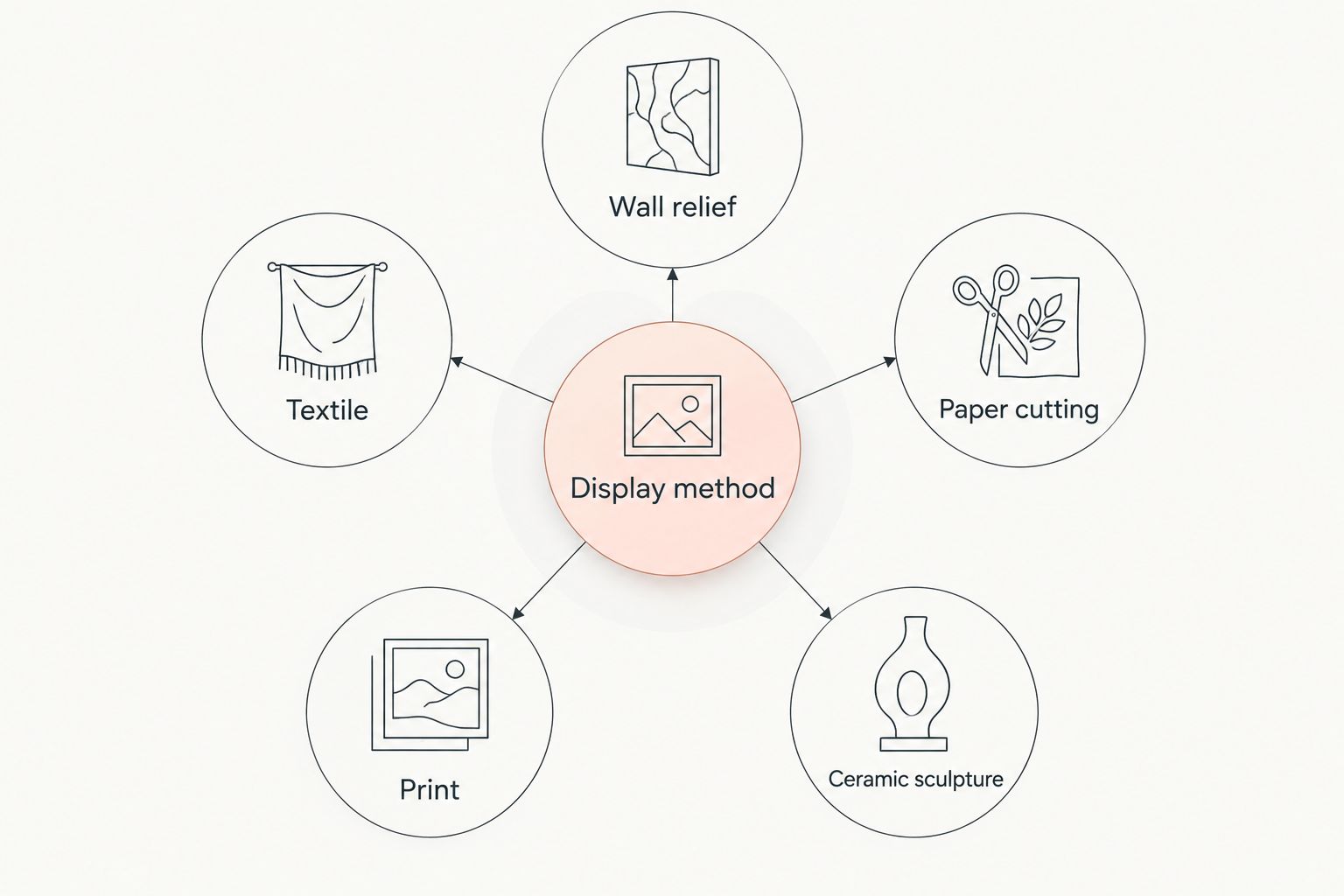
Before ordering, mark the intended outline on the wall with removable paper. Include the frame, textile support, or shelf in that outline rather than measuring only the tree image.
Then stand where you normally see the wall. If the trunk disappears into the surrounding detail, the composition does not read clearly from that position; moving closer is a different display choice, not a fix for the original location.
How the options are ranked
This 2026 ranking puts direct wall-display suitability first, followed by material character, attribution, readability, and care. It compares formats and the supplied product description; it does not claim hands-on testing or rank individual makers against one another.
The wall relief leads because it answers the requested display purpose most directly when documented for hanging. The named ceramic work remains a separate recommendation because artistic attribution does not establish installation suitability.
Which tree of life folk art should you choose?
Choose a purpose-made wall relief if your non-negotiable requirement is dimensional art hanging directly on the wall. Choose a textile, paper cutting, or print when its material and presentation better suit the room.
Choose Folk Heart Cafe’s tree of life folk art option when Leopoldo Aguilar's attribution and barro policromado technique are your priorities. Confirm how the particular object should be displayed before committing to a wall arrangement around it.
FAQ
What's the best tree of life folk art for a wall?
A purpose-made Tree of Life wall relief is the default choice for dimensional wall display. Confirm that its construction, hanging system, and installation instructions support your intended placement.
Can I hang a ceramic Tree of Life sculpture on the wall?
Hang a ceramic Tree of Life sculpture only when its maker explicitly specifies wall mounting. Decorative branches, openings, and loops are not proof of safe attachment points.
Is Folk Heart Cafe’s Tree of Life a wall hanging?
The supplied description does not identify Folk Heart Cafe’s Tree of Life as a wall hanging. It identifies Leopoldo Aguilar, barro policromado, and Ocotlán; confirm the display method separately.
Is a Tree of Life print better than a paper cutting?
Choose a print for a flat image and a paper cutting for actual cut edges and open spaces. Neither format is automatically better; authorship, condition, framing, and your preferred surface determine the choice.
How do I know whether Tree of Life art is handmade?
Look for an explicit description of the making process and an identified artist or workshop. The Tree of Life motif alone does not establish that an object was handmade.
What should I check before buying Tree of Life wall decor?
Check the complete dimensions, material, attribution, condition, and display instructions. For projecting or heavy work, also confirm weight and the specified mounting or support system.
Where should I display detailed Tree of Life artwork?
Display detailed Tree of Life artwork where you can see its main structure from your normal viewing position. Check reflections, nearby visual clutter, direct light, and access for safe cleaning before choosing the final location.
One last thing
Ask for a photograph of the back before buying dimensional wall art. The front shows the composition; the back helps establish whether the object was designed to hang at all. That distinction matters more than how convincingly a listing photographs it against a wall.

