

Best overall: a wide-mouth, glazed Mexican pottery pitcher documented for beverage use; best for a colorful table: a similarly documented Talavera pitcher. Best for a small gathering: a compact pitcher; best for strained sangria: a narrow-neck pitcher—this Folk Heart Cafe guide compares shapes and buying criteria, not unverified product listings.
- Choose Mexican pottery pitchers for sangria with documented beverage suitability before comparing decoration.
- A wide-mouth pitcher is the best default when sangria includes cut fruit.
- Talavera pitchers suit colorful tables, but painted decoration does not establish food-contact safety.
- Folk Heart Cafe recommends treating undocumented pottery as decoration, not sangria serveware.
Why this matters
Sangria puts acidic wine and fruit in contact with a vessel's interior. The FDA warns that some ceramic foodware can release lead into food or drink; a glazed surface alone does not establish suitability.
That makes this a safety decision before it becomes a decorating decision. Mexican origin, hand-painted decoration, and an attractive finish do not answer whether a particular pitcher belongs on your drinks table.
For your 2026 shortlist, separate two questions: is the exact piece documented for beverage contact, and does its shape make sangria easy to serve? A decorative pitcher that fails the first question does not become a serving vessel because it passes the second.
What makes the best Mexican pottery pitchers for sangria
Use these criteria before choosing a pattern. Documentation comes first; shape comes second.
- Beverage suitability: Look for an explicit statement covering the exact pitcher and its intended food or beverage use. A decorative-use warning rules it out.
- Glaze documentation: Ask what supports the food-contact claim, including relevant lead and cadmium testing. A country-of-origin label is not a test report.
- Fruit access: Choose an opening that lets you add, remove, and clean away the fruit you actually use.
- Pouring control: Assess the handle, spout, and balance together. A beautiful handle still needs to accommodate your grip.
- Interior condition: Reject a serving candidate with chips, cracks, flaking glaze, or an interior you cannot inspect adequately.
- Care requirements: Follow the maker's instructions for washing and temperature changes. Do not assume pottery tolerates a dishwasher or sudden cooling.
Apply three checks to every candidate: documentation, condition, and handling. Passing one does not compensate for failing another, and no decorative style receives an exemption.
Mexican pottery pitchers at a glance
These are buying categories, not named products. A particular pitcher can fit more than one category; choose the row that matches your main serving problem.
| Rank and pitcher type | Best for | Standout feature to seek | Key limitation | Verdict |
|---|---|---|---|---|
| 1. Wide-mouth glazed pitcher | Sangria with cut fruit | Accessible opening and controlled spout | The spout still needs checking for fruit blockage | Buy after verification |
| 2. Talavera pitcher | A colorful entertaining table | A painted ceramic surface that complements the setting | The style name does not establish beverage suitability | Buy after verification |
| 3. Compact pottery pitcher | A small table or lighter refill | A size and handle you can comfortably control | Requires more refilling for a larger gathering | Buy for smaller servings |
| 4. Narrow-neck pottery pitcher | Sangria strained before serving | A neck suited to pouring liquid without large fruit pieces | Restricted access complicates fruit removal and cleaning | Buy for strained sangria |
Match the shape to the drink
Decide whether fruit will remain inside the pitcher before you shop. An open mouth supports adding and removing cut fruit; a narrow neck makes more sense when you strain the drink into the serving vessel.
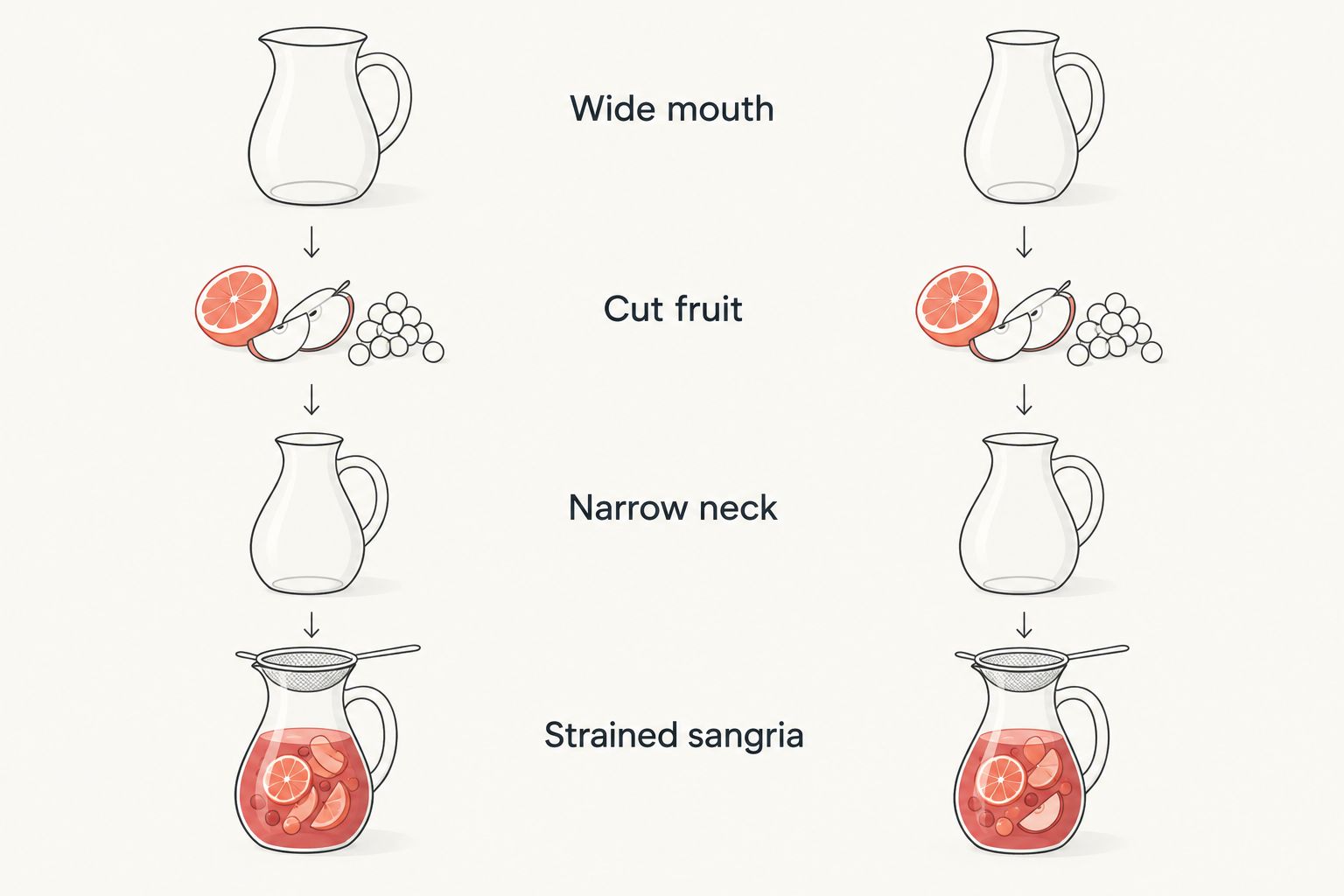
Neither shape establishes food-contact safety. Check the documentation separately, even when the pitcher looks exactly right for your recipe.
1. Wide-mouth glazed pitcher: best for sangria with cut fruit
A wide-mouth pitcher is the strongest default when you serve sangria with fruit inside the vessel. The accessible opening lets you arrange ingredients, retrieve remaining pieces, and inspect the interior after washing.
Look beyond the mouth, though. A generous opening paired with a restrictive spout still creates a serving problem when fruit collects near the outlet.
Wide-mouth pitcher pros:
- Gives you direct access for adding and removing cut fruit.
- Makes the interior easier to inspect than a restricted opening.
- Lets you use a serving utensil if the opening accommodates it.
Wide-mouth pitcher cons:
- Fruit can still obstruct an unsuitable spout.
- A large body becomes harder to control as you add liquid.
- An open shape does not provide the protection of a fitted lid.
Before buying, check whether the handle leaves room for your fingers without pressing them against the body. When the pitcher arrives, assess the empty grip before attempting a filled pour.
Best for: Hosts who want wine and cut fruit in the same serving vessel.
Verdict: Buy a documented beverage-safe wide-mouth pitcher as the default for fruit-filled sangria.
2. Talavera pitcher: best for a colorful entertaining table
A Talavera pitcher brings painted ceramic decoration to the table. Choose it when the pitcher should contribute to the setting rather than disappear among clear glasses and plain dishes.
The purchase still depends on the exact piece. The words Talavera, traditional, or handmade do not establish that a pitcher is suitable for acidic beverages, and appearance does not verify its origin.
Talavera pitcher pros:
- Adds a patterned element to an otherwise simple table.
- Offers a clear decorative direction for coordinating serveware.
- Can serve both a visual and practical role when beverage suitability is documented.
Talavera pitcher cons:
- Decorative appeal can distract from missing food-contact information.
- The style name does not tell you how the handle or spout performs.
- A patterned exterior cannot establish the condition of the interior.
For a 2026 purchase, request the same documentation you would require for plain ceramic serveware. If geographic origin or a particular craft tradition matters to you, ask for provenance separately rather than treating it as a substitute for safety information.
Best for: Hosts who want a colorful centerpiece that also meets their serving requirements.
Verdict: Buy for the decoration only after the exact pitcher passes the beverage-use checks.
3. Compact pottery pitcher: best for a small table
A compact pitcher suits a table where serving space and handling matter more than holding the entire batch. Keep the remaining sangria in a separate suitable container and refill the serving pitcher as needed.
Compact is a relative description, not a capacity guarantee. Check the actual dimensions and stated capacity, then compare them with your table and your ability to lift the vessel comfortably.
Compact pitcher pros:
- Takes less table space than a larger pitcher of comparable shape.
- Holds a smaller amount of liquid per refill.
- Lets you separate batch preparation from table service.
Compact pitcher cons:
- Needs more frequent refilling when you serve more drinks.
- A small opening can restrict access for fruit and washing.
- A small body does not guarantee a comfortable handle.
Do not choose by silhouette alone. A squat pitcher with a cramped handle can be less practical than a taller design with adequate finger clearance.
Test the intended table position with your glasses and dishes before committing to a size. Leave enough room to lift the pitcher without reaching over another person's glass.
Best for: Smaller gatherings, crowded tables, and hosts who prefer manageable refills.
Verdict: Buy compact when control and table space matter more than batch capacity.
4. Narrow-neck pottery pitcher: best for strained sangria
A narrow-neck pitcher belongs on the shortlist when you strain sangria before serving. Pour the prepared liquid into the pitcher and place any fruit garnish directly in the glasses.
That arrangement avoids trying to move large fruit pieces through a restricted neck. It also separates the presentation of the drink from the practical task of removing soaked fruit afterward.
Narrow-neck pitcher pros:
- Suits a serving method that keeps large fruit pieces outside the pitcher.
- Supports garnishing each glass separately.
- Offers an alternative silhouette when a wide-mouth vessel does not suit your table.
Narrow-neck pitcher cons:
- Makes retrieving trapped fruit more difficult.
- Restricts access for washing and inspecting the interior.
- Requires checking that your cleaning tools reach the base.
Do not mistake a vase-shaped object for a beverage pitcher. Confirm the intended use, inspect the pouring lip, and check whether the handle supports a controlled grip.
Best for: Hosts who serve strained sangria with garnish added to individual glasses.
Verdict: Buy for strained sangria; skip for fruit-filled service if access is restricted.
How we ranked the pitcher types
The ranking prioritizes beverage suitability, fruit access, pouring control, condition, and care. Wide-mouth pitchers take the default position because they address the added handling task created by cut fruit.
Talavera earns a separate recommendation for table decoration, compact pitchers for smaller servings, and narrow-neck pitchers for strained drinks. These are use-case recommendations, not claims that one maker outperforms another.
For Folk Heart Cafe readers, the best Mexican pottery pitchers for sangria pair documented beverage suitability with a shape that matches the way the drink is served. No claim of hands-on testing or product certification is implied by this guide.
Check before the first pour
Use a two-stage check before serving guests: inspect the dry pitcher, then assess the pour with water. A water test reveals handling problems; it does not establish chemical safety.
Inspect the dry pitcher
Read the care instructions and any markings on the base. Check the rim, spout, handle attachments, and interior for damage, and keep any documentation that identifies the exact piece.
If the labeling limits the pitcher to decorative use, stop there. Do not attempt to make it suitable with a home coating, seasoning routine, or an improvised liner.
Assess the pour with water
On a clear surface, add water gradually and test your grip. Check whether the spout directs liquid into a glass without forcing you into an awkward wrist position.
Use two hands when needed for control. If the handle feels insecure or the pitcher becomes uncomfortable before it reaches your intended serving level, choose a smaller vessel rather than forcing the full batch into it.
Keep the roles separate: documentation addresses intended food contact; the water check addresses handling. Neither replaces the other.
Which pitcher should you choose in 2026?
Choose a wide-mouth, glazed Mexican pottery pitcher with documented beverage suitability unless you have a specific reason to prefer another shape. It is the most practical starting point for sangria served with cut fruit.
Choose Talavera when painted decoration is the priority, compact pottery when table space is tight, and a narrow neck when you strain the drink. Apply the same safety checks to every option.
If a favorite piece lacks adequate documentation, keep it out of beverage service. It can remain a decorative object while a verified food-contact vessel handles the sangria.
FAQ
What's the best type of Mexican pottery pitcher for sangria?
A wide-mouth pitcher documented for beverage use is the best default for sangria served with cut fruit. Check the handle, spout, interior condition, and care instructions before choosing the decoration.
Are Talavera pitchers safe for sangria?
A Talavera pitcher is suitable only when the exact piece is documented for the intended beverage use. The decorative style alone does not establish safety for acidic wine and fruit.
Can I serve sangria in a decorative pottery pitcher?
Do not serve sangria in a pitcher labeled for decorative use. Use a separate vessel documented for food or beverage contact, and keep the decorative piece outside drinks service.
Does a glazed interior mean a pottery pitcher is lead-free?
No, a glazed interior does not establish that a pitcher is lead-free or suitable for sangria. Ask for documentation supporting the food-contact claim rather than judging the surface by appearance.
Should I choose a wide mouth or a narrow neck?
Choose a wide mouth when fruit remains in the pitcher and a narrow neck when you serve strained sangria. Check cleaning access in either case.
How do I check whether a pitcher pours comfortably?
After confirming beverage suitability, test the pitcher with water on a clear surface. Assess the grip, balance, and spout before serving guests; this handling test does not establish chemical safety.
Can Mexican pottery pitchers go in the dishwasher?
Use a dishwasher only when the maker's instructions permit it for the exact pitcher. Do not assume that a glazed finish or a traditional style establishes dishwasher compatibility.
One last thing
For your 2026 table, judge the inside before admiring the outside. A pitcher can suit the room perfectly and still be the wrong vessel for sangria.
Folk Heart Cafe's recommendation is simple: keep undocumented pottery decorative, and let verified serveware carry the drink. For a display-focused alternative, explore the kitchen-decor guide below rather than treating every pottery shape as functional tableware.

