

Best overall: a Catrina-style figure. Best for a remembrance display: a skeleton couple. Best for a lively vignette: a skeleton musician. Best for a narrow shelf: a miniature skeleton. This Folk Heart Cafe guide compares Day of the Dead figurines for Halloween decor by display purpose, with cultural context and a practical selection checklist for 2026.
- For Folk Heart Cafe readers, Catrina-style figures are the best Day of the Dead figurines for Halloween decor focal points.
- Choose skeleton couples for a personal remembrance display, musicians for movement, and miniatures for narrow shelves.
- Día de los Muertos honors deceased loved ones; keep remembrance displays separate from horror props.
- Check dimensions, materials, base stability, and care instructions before choosing any figurine.
Why this matters
Día de los Muertos is a remembrance tradition, not a Mexican version of Halloween. Its observances center on honoring deceased loved ones, commonly on November 1 and November 2. Halloween falls on October 31, so the decorations often share a seasonal window without sharing the same meaning.
That distinction should shape your 2026 display. A decorative shelf arrangement and a personal ofrenda serve different purposes; decide which you are creating before choosing figures or props.
At Folk Heart Cafe, the Lady of the Night listing is a starting point for checking the actual piece. Confirm its appearance, dimensions, material, and care details rather than assuming those attributes from its name.
What makes the best Day of the Dead figurines?
The best choice fits both your display and the subject. Use these criteria before comparing decorative styles:
- Recognizable subject: Decide whether you want a Catrina, a couple, a musician, or a small skeleton character. Each creates a different focal point.
- Display fit: Check the full height, width, and depth, including hats, instruments, skirts, and projecting arms.
- Stable placement: Look for a base suited to your surface. Keep fragile figures away from shelf edges and busy household routes.
- Material and care: Follow the maker's instructions. Do not assume a painted figure tolerates water, outdoor exposure, or wet cleaning.
- Cultural context: Separate celebratory skeleton imagery from gore, horror scenes, and caricatures of Mexican people.
- Clear documentation: Prefer listings that identify materials, dimensions, and makers. Treat missing information as a question to resolve, not permission to guess.
For a 2026 purchase, evaluate the current listing rather than relying on an old saved image. A photograph communicates style, but it does not establish weight, construction, or safe placement.
Day of the Dead figurines at a glance
These are ranked figurine styles, not tested products. The order reflects how clearly each style answers a different decorating need.
| Rank and figurine style | Best for | Standout feature | Key limitation |
|---|---|---|---|
| 1. Catrina-style figure | A single focal display | An elegantly dressed skeletal figure with a recognizable silhouette | Hats and clothing can require substantial display space |
| 2. Skeleton couple | A personal remembrance arrangement | Two figures presented in relationship | A romantic pairing does not suit every remembrance subject |
| 3. Skeleton musician | A lively shelf vignette | An instrument and performance pose | Projecting details complicate placement and packing |
| 4. Miniature skeleton | A narrow shelf or small grouping | A compact character that fits among existing objects | Small details are harder to appreciate from across a room |
1. Catrina-style figure: best for a focal display
A Catrina-style figure depicts an elegantly dressed female skeleton, often wearing an elaborate hat or gown. The imagery is closely associated with Mexican popular art and Día de los Muertos. Choose this style when you want one recognizable subject rather than an arrangement crowded with unrelated seasonal objects.
Best for: An entry console, mantel, or open shelf where the figure has room around its silhouette.
Catrina-style figure pros
- A distinctive silhouette establishes a clear focal point.
- Formal clothing provides decorative interest without extra props.
- A single figure supports a restrained arrangement.
- The subject connects directly with familiar Día de los Muertos imagery.
Catrina-style figure cons
- Wide hats and skirts need clearance beyond the base.
- Thin or projecting details require careful handling when present.
- An oversized figure can overwhelm a shallow shelf.
Start with the figure, then decide whether anything else is necessary. For a simple 2026 arrangement, use 1 focal figure and no more than 2 supporting objects as a planning rule, not a traditional requirement. A plain backdrop helps you judge whether the shape reads clearly.
Avoid placing a tall figure where a cabinet door, curtain, or passing sleeve can strike it. Check overhead clearance as well as shelf depth; a hat that fits in a photograph does not necessarily fit beneath your next shelf.
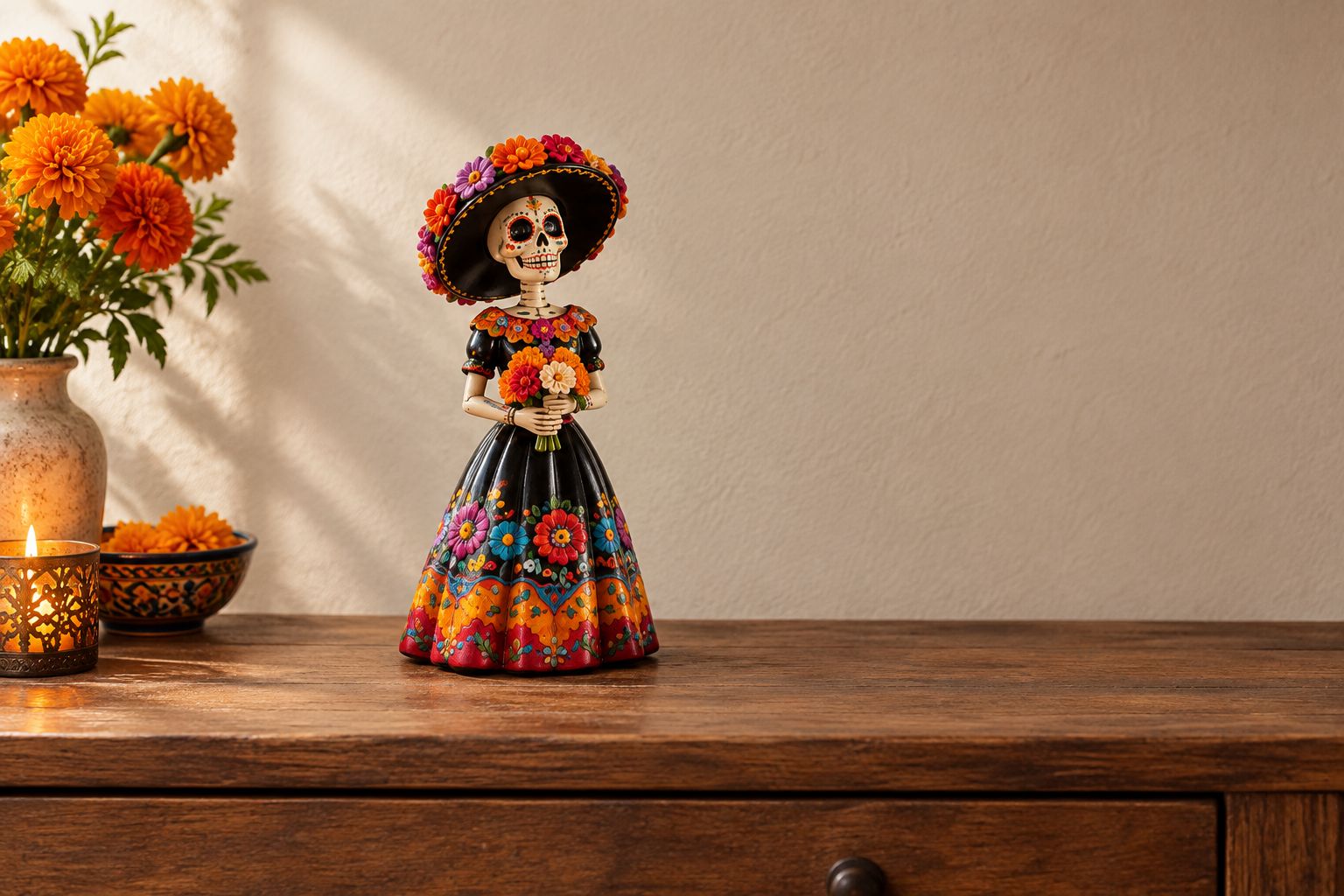
Verdict: Buy a Catrina-style figure if you want one clear focal point; skip it if the hat or gown exceeds your display space.
2. Skeleton couple: best for a remembrance arrangement
A skeleton couple presents two figures together, often in affectionate or companionable poses. The relationship becomes the subject, making this style a useful choice when a paired figure has personal meaning for your household.
Best for: A remembrance arrangement where the pairing genuinely relates to the people being honored.
Skeleton couple pros
- The relationship gives the arrangement a specific narrative.
- A paired composition creates a focal group without separate matching figures.
- The subject can sit alongside meaningful photographs or keepsakes.
Skeleton couple cons
- A romantic pose is not appropriate for every relationship.
- Two figures can require a wider footprint than a single upright figure.
- Generic wedding imagery can distract from the people you intend to remember.
Choose the relationship before the decorative details. If the figure does not connect with your loved ones, a photograph and a meaningful personal object are a better starting point than a couple selected merely to complete a theme.
For a household remembrance display in 2026, let personal meaning determine placement. An ofrenda is not simply a decorated shelf, and a figurine is not a required substitute for photographs, offerings, or family practices.
Keep horror props elsewhere. The figures should read as companions in a remembrance setting, not as characters in a frightening scene.
Verdict: Buy a skeleton couple when the relationship has personal meaning; skip it when the pairing is only decorative filler.
3. Skeleton musician: best for a lively shelf vignette
A skeleton musician uses an instrument and a performance pose to create a sense of activity. It suits an informal decorative arrangement where you want an expressive character rather than a formal, upright centerpiece.
Best for: A shelf or console arrangement built around music, celebration, or a loved one's musical interests.
Skeleton musician pros
- The instrument makes the character's activity easy to understand.
- An angled pose adds variety beside upright books or frames.
- A musical subject can connect with a specific personal memory.
Skeleton musician cons
- Instruments and extended limbs need protected space.
- Small instrument details demand careful packing.
- Several musicians can make a small surface feel crowded.
Check the instrument's position before choosing a location. A projecting guitar, bow, or trumpet changes the usable footprint even when the base looks compact. Measure the widest point, not just the feet.
A musician does not need a full band to make sense. Start with a single character, then view it from the doorway, from your usual seat, and up close: 3 viewing positions that reveal whether the pose remains readable.
For your 2026 setup, choose supporting objects that explain the musical connection rather than simply repeating skeleton imagery. Keep personal keepsakes prominent if remembrance is the purpose.
Verdict: Buy a skeleton musician for an expressive vignette; skip a multi-figure band when the shelf cannot protect its projecting details.
4. Miniature skeleton: best for a narrow shelf
A miniature skeleton brings the subject into a small display without requiring a tall centerpiece. It works best where you can see it at close range, such as an open bookshelf or a protected desktop corner.
Best for: Small spaces and close-view arrangements where a larger figure would compete with existing objects.
Miniature skeleton pros
- A compact figure fits into an established shelf arrangement.
- Small characters allow a focused grouping without a tall centerpiece.
- Close placement lets you appreciate expressions and painted details.
Miniature skeleton cons
- Fine details disappear at room-viewing distance.
- A small figure is easy to obscure behind books or other decorations.
- Small decorative objects need placement away from children and pets.
Choose the viewing location before choosing the miniature. If the figure sits above eye level or behind a plant, its small footprint offers little benefit because you cannot read the subject.
Keep miniatures on a stable surface rather than balancing them on uneven seasonal filler. Do not treat a decorative figurine as a toy unless its maker explicitly identifies it for that use.
Verdict: Buy a miniature skeleton for close viewing; skip it when you need decoration that reads from across the room.
How the figurine styles are ranked
This ranking prioritizes display purpose, recognizable subject, physical fit, and placement requirements. It does not assign unverified quality scores to products or claim hands-on testing.
Catrina-style figures take the default position because their silhouette supports a single focal display. Couples, musicians, and miniatures answer more specific needs: personal relationships, expressive activity, and limited space. A lower position does not mean poorer craftsmanship.
Folk Heart Cafe readers should apply the same distinction to individual listings: style determines the role; documented construction and care determine whether the actual piece suits your home.
Which Day of the Dead figurines should you choose?
Choose a Catrina-style figure if you are undecided and want a focal display. Choose a skeleton couple only when the pairing matters, a musician when music explains the arrangement, or a miniature when the viewing distance is short.
Before placing anything in your 2026 display, make three decisions:
- Purpose: Is this seasonal decoration or a personal remembrance arrangement?
- Placement: Can the surface support the full figure without overhang or contact with nearby objects?
- Care: Can you follow the maker's handling, cleaning, and storage instructions?
Keep delicate figures away from open flames. If you want candlelight nearby, separate the decorative figure from heat and follow the candle manufacturer's safety instructions; do not assume any figurine material is heat-safe.
FAQ
What's the best Day of the Dead figurine for Halloween decor?
A Catrina-style figure is the best default for a single focal display. Choose a skeleton couple for a meaningful relationship, a musician for an expressive vignette, or a miniature for close viewing.
Are Day of the Dead decorations the same as Halloween decorations?
No. Día de los Muertos centers on remembering deceased loved ones, while Halloween is a separate observance. Keep personal remembrance arrangements distinct from gore and horror scenes.
When should I display Day of the Dead figurines in 2026?
If your display follows Día de los Muertos, plan around November 1 and November 2, 2026. Household and community practices vary, and a decorative collection can also remain on display outside the holiday.
Can I put a skeleton figurine on a home altar?
Yes, when the figure fits your household's remembrance practices and has a meaningful role. A figurine is optional; photographs, personal memories, and family traditions should guide the arrangement.
Can Day of the Dead figurines stay outside?
Use a figurine outdoors only when its maker explicitly identifies it for outdoor use. Appearance alone does not establish resistance to rain, sunlight, frost, or moisture.
How do I clean a painted Day of the Dead figurine?
Follow the maker's cleaning instructions for the specific material and finish. Do not assume water, household cleaners, or vigorous brushing are safe for painted surfaces and delicate details.
What should I check before choosing a figurine from Folk Heart Cafe?
Check the specific listing's dimensions, materials, care instructions, and photographs. Confirm the full silhouette fits your display space rather than judging fit from the base alone.
One last thing
Measure the empty space around the figure, not just the space underneath it. Hats, instruments, and extended arms are often the parts that complicate placement. A paper outline of the listed width and depth helps you check the footprint before committing to a location.
Then remove anything that competes with the subject. A clear silhouette and a meaningful setting do more for the arrangement than another unrelated seasonal prop.

